Copybook
A website theme for online and part-time course providers and colleges, in Astro and in Next.js with Sanity: the next start date on the first screen, a course catalogue with filters, a cost-after-funding calculator, a page per course, funding, employers and help. 31 pages, 20 sections, 2 presets, light and dark, WCAG 2.2 AA.
Theme for course providers and colleges, for Astro and Next.js + Sanity
What Copybook is for
The site for an online or part-time course provider: when can I start and what will it cost me, answered on the first screens, in two editions: Astro, or Next.js with a Sanity Studio. 31 pages, 20 sections and 2 presets, light and dark, WCAG 2.2 AA.
Home, the catalogue, a course, funding, how study works, employers, about and help, ready for your school.
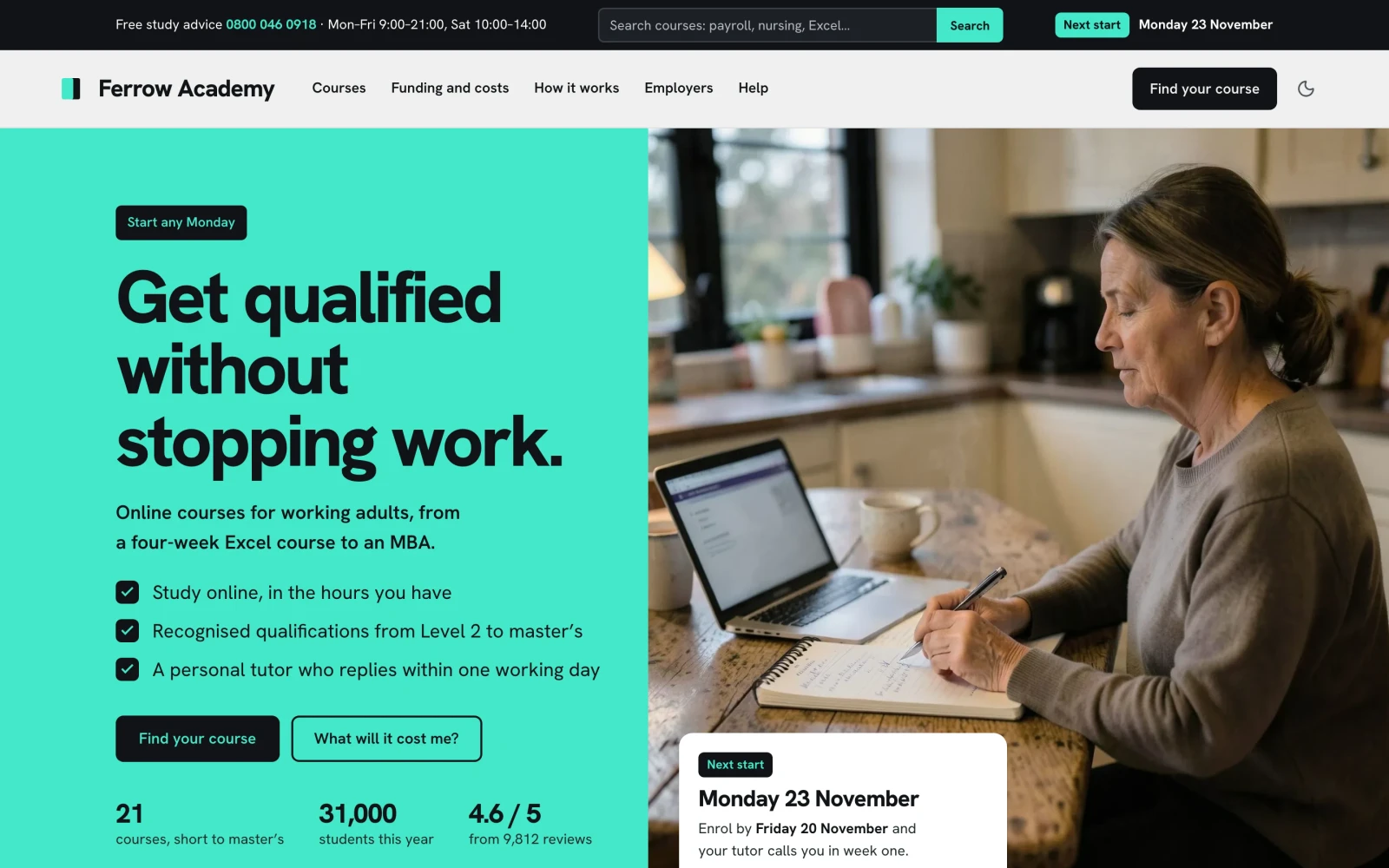
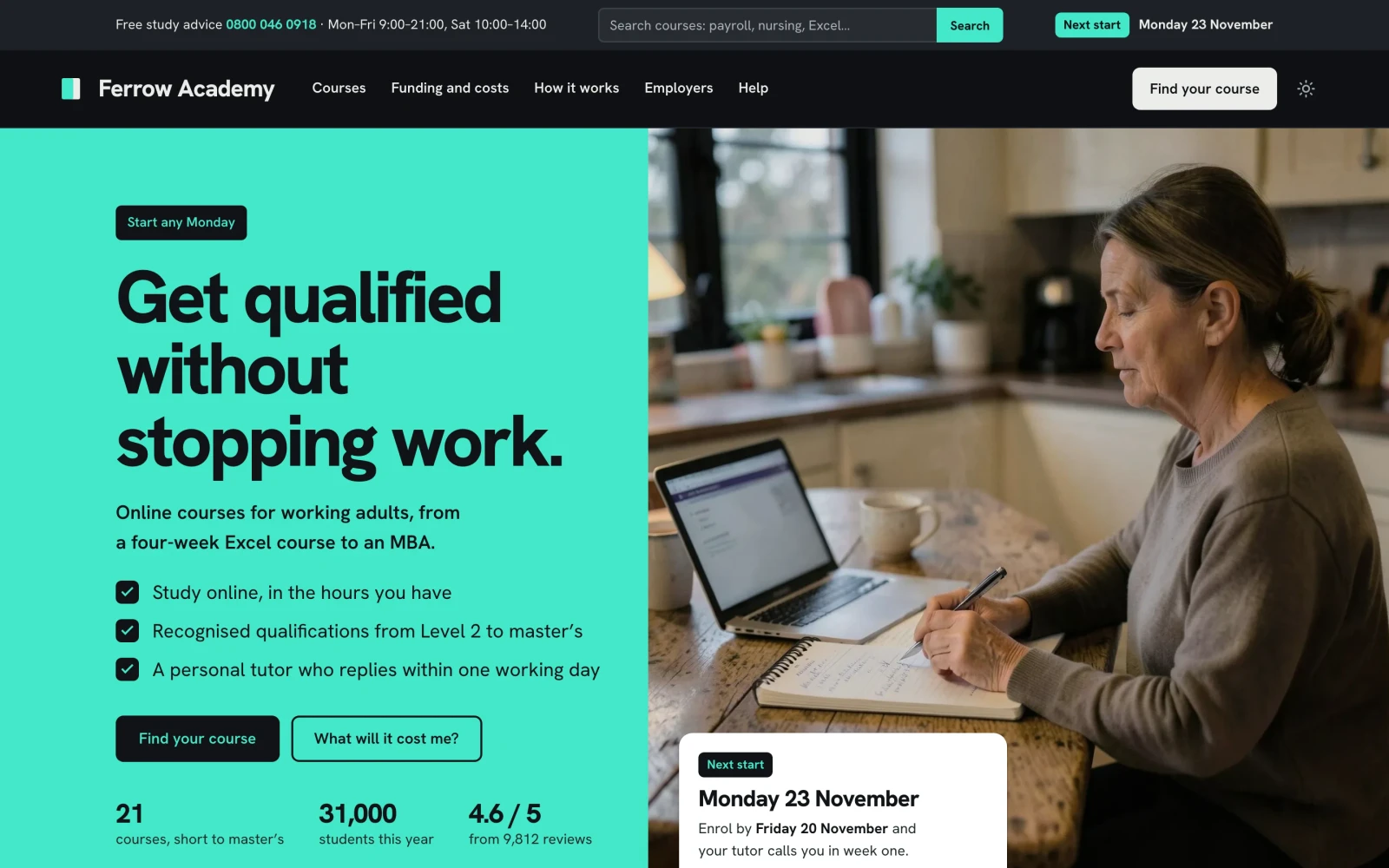
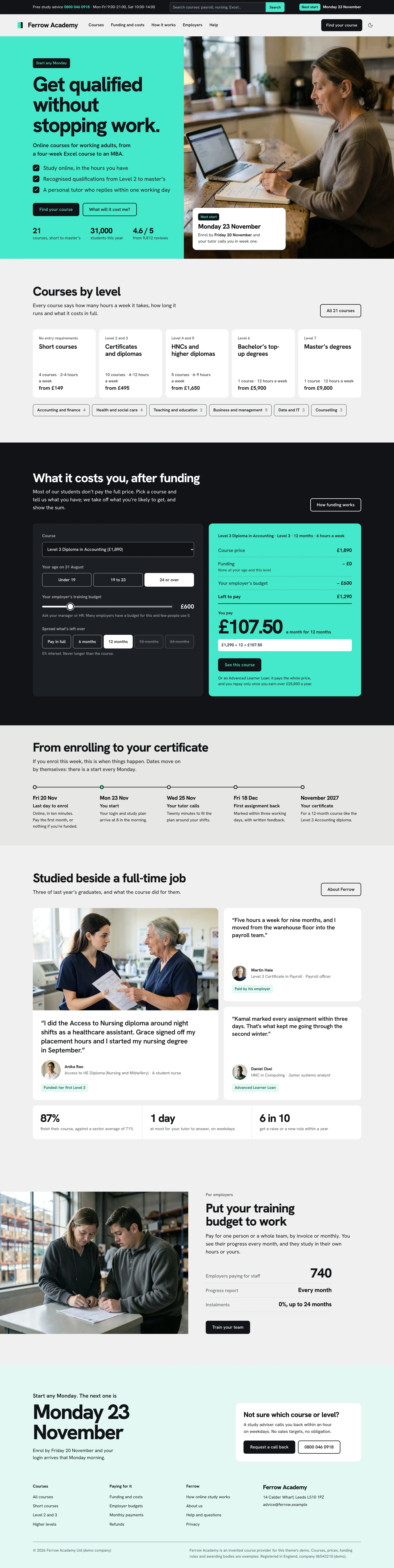
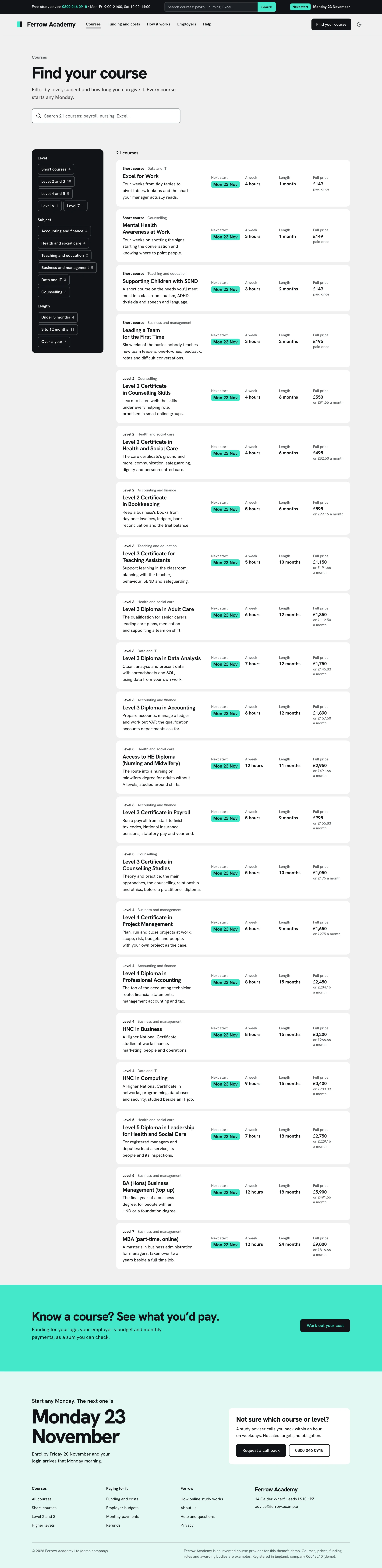
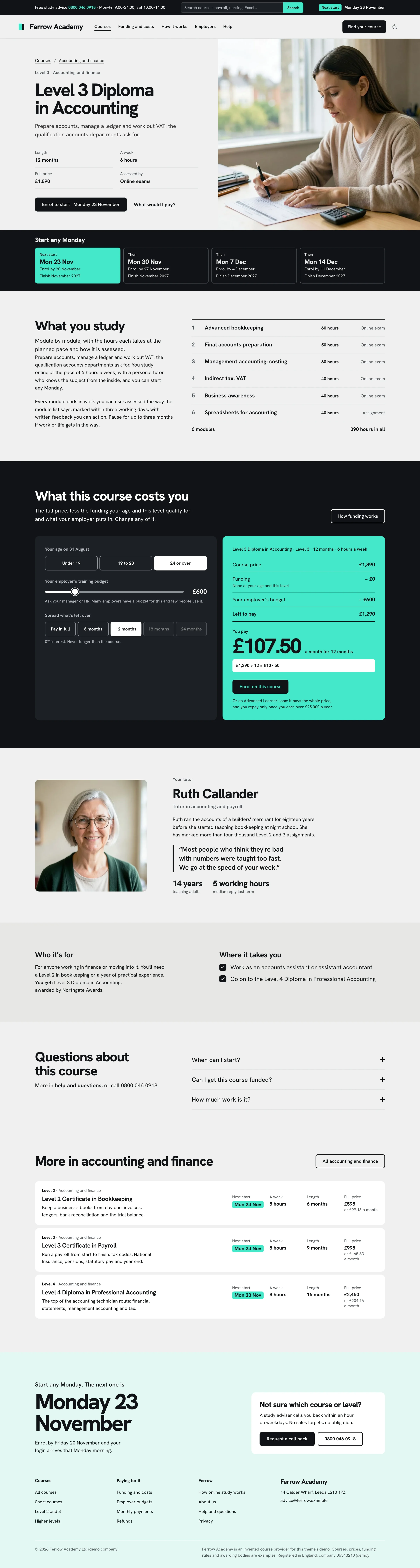
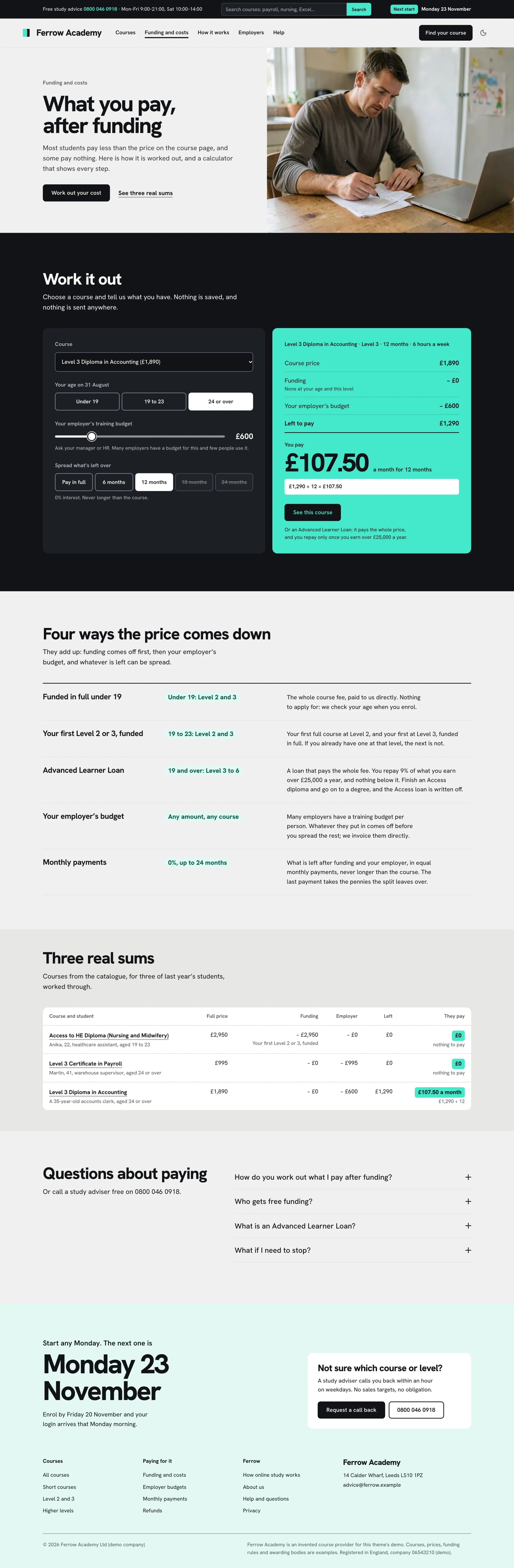
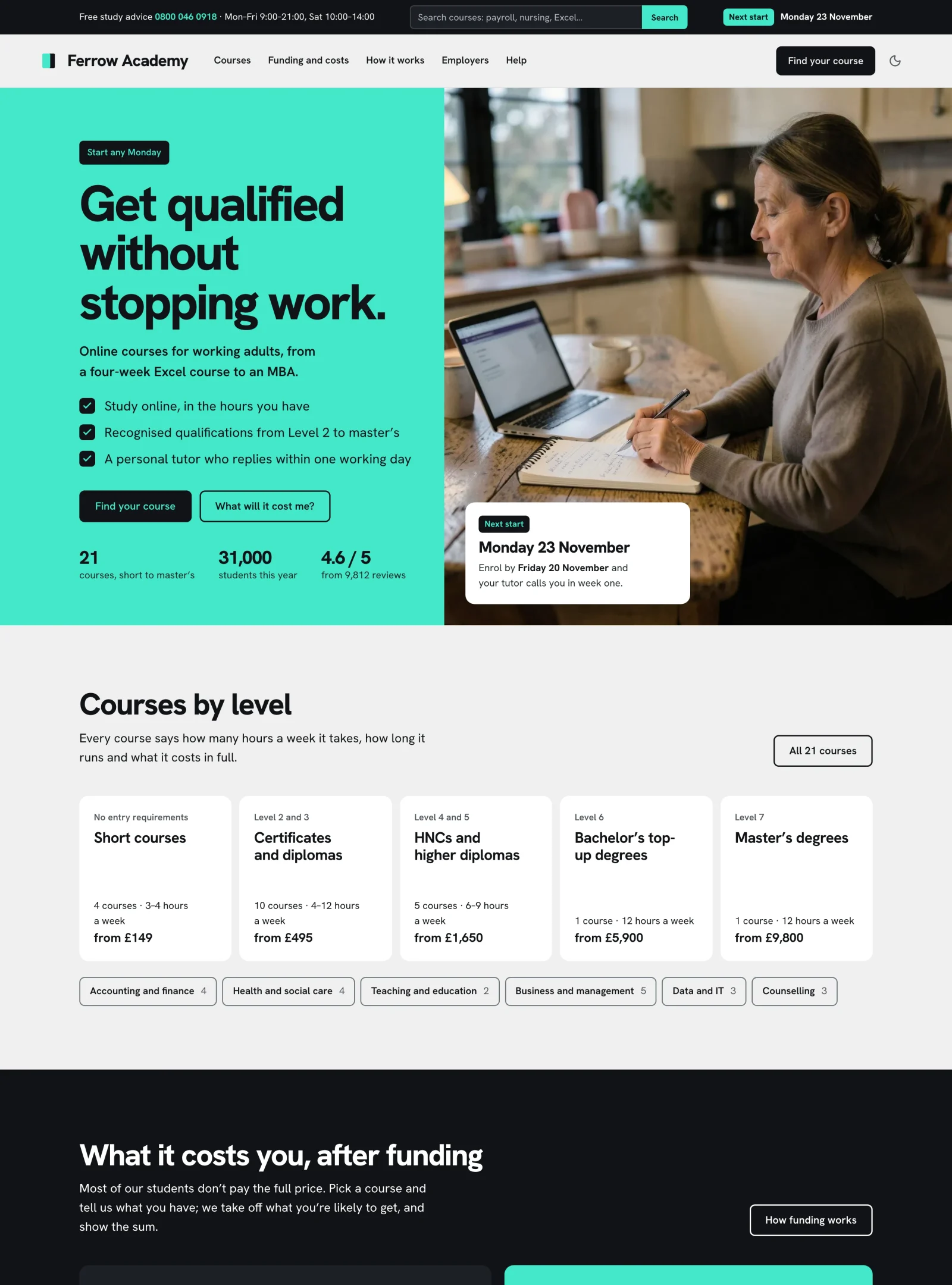
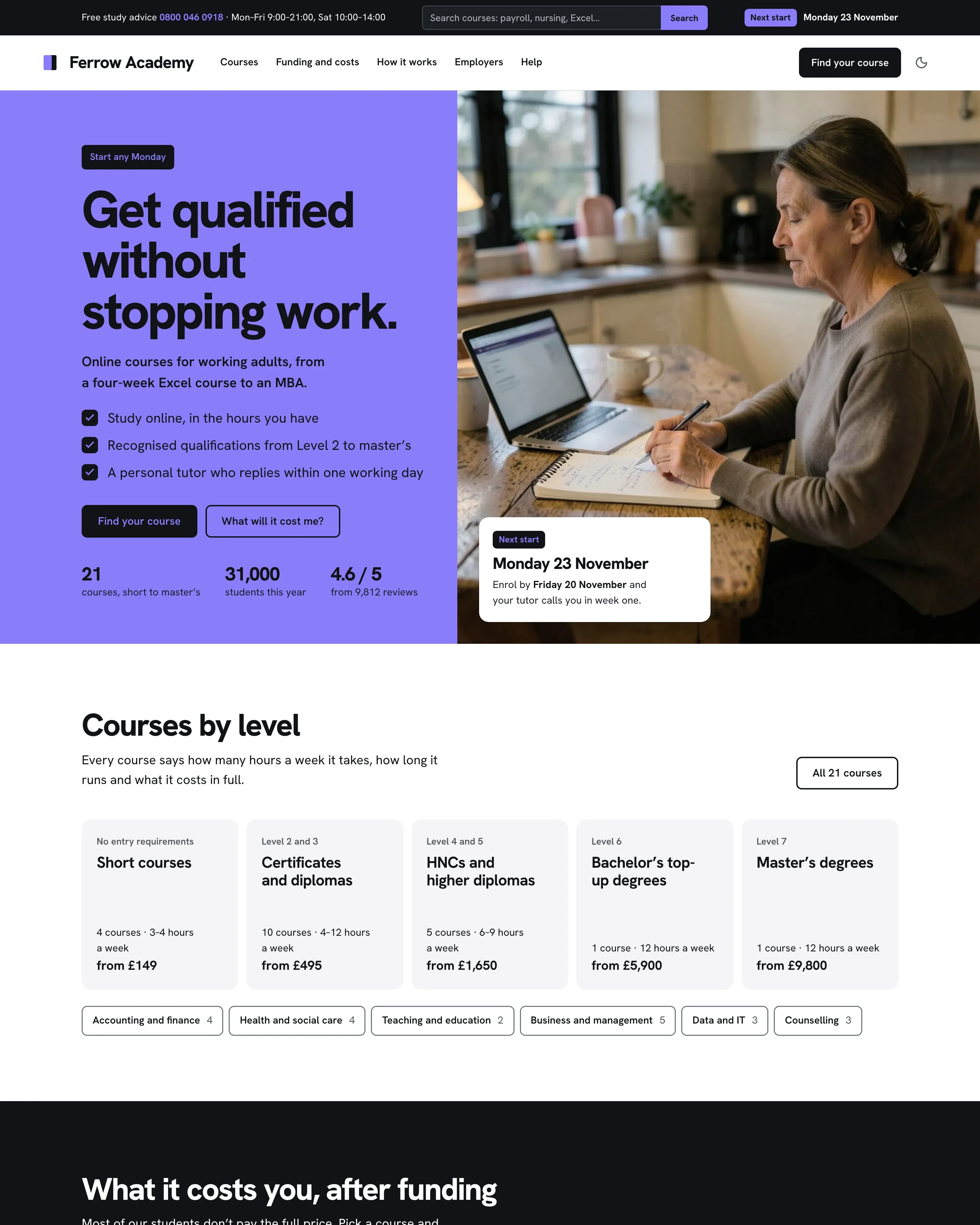
Every page as it ships, with the invented provider Ferrow Academy: 21 online courses in six subjects, from a short Excel course to a master’s, with funding rules, tutors and graduates. Switch to dark to see the other mode, and click a page to see all of it.
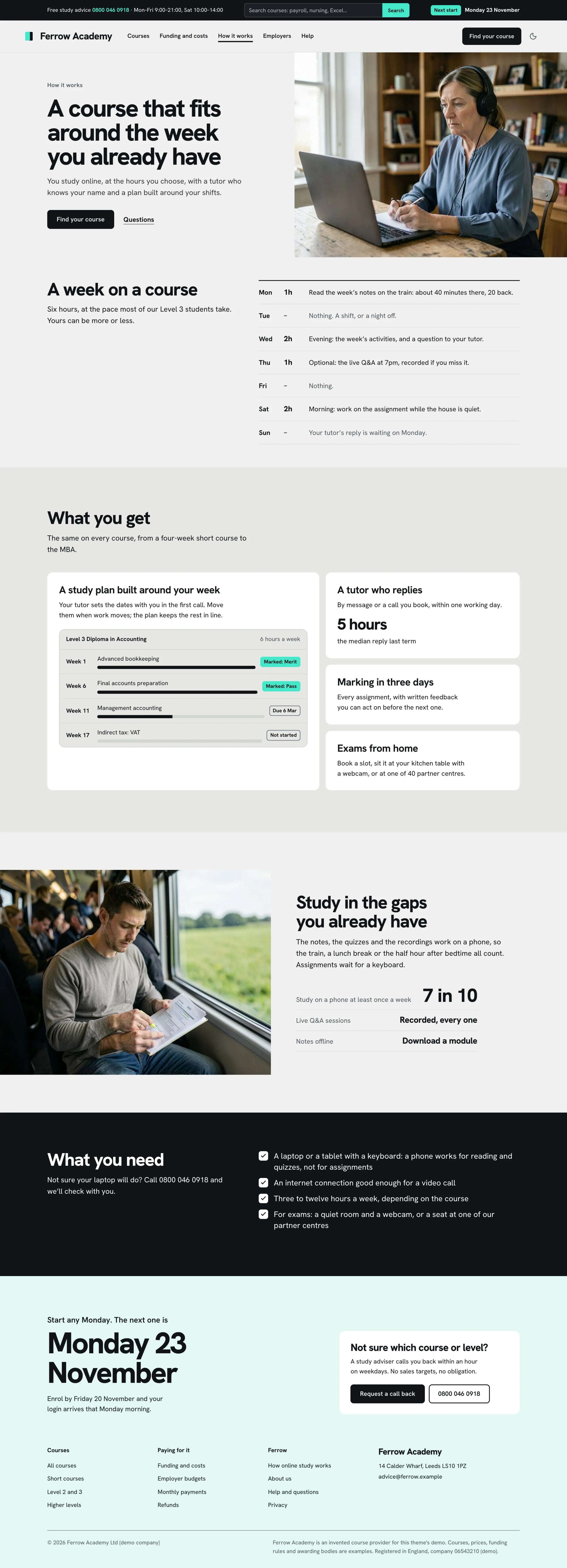
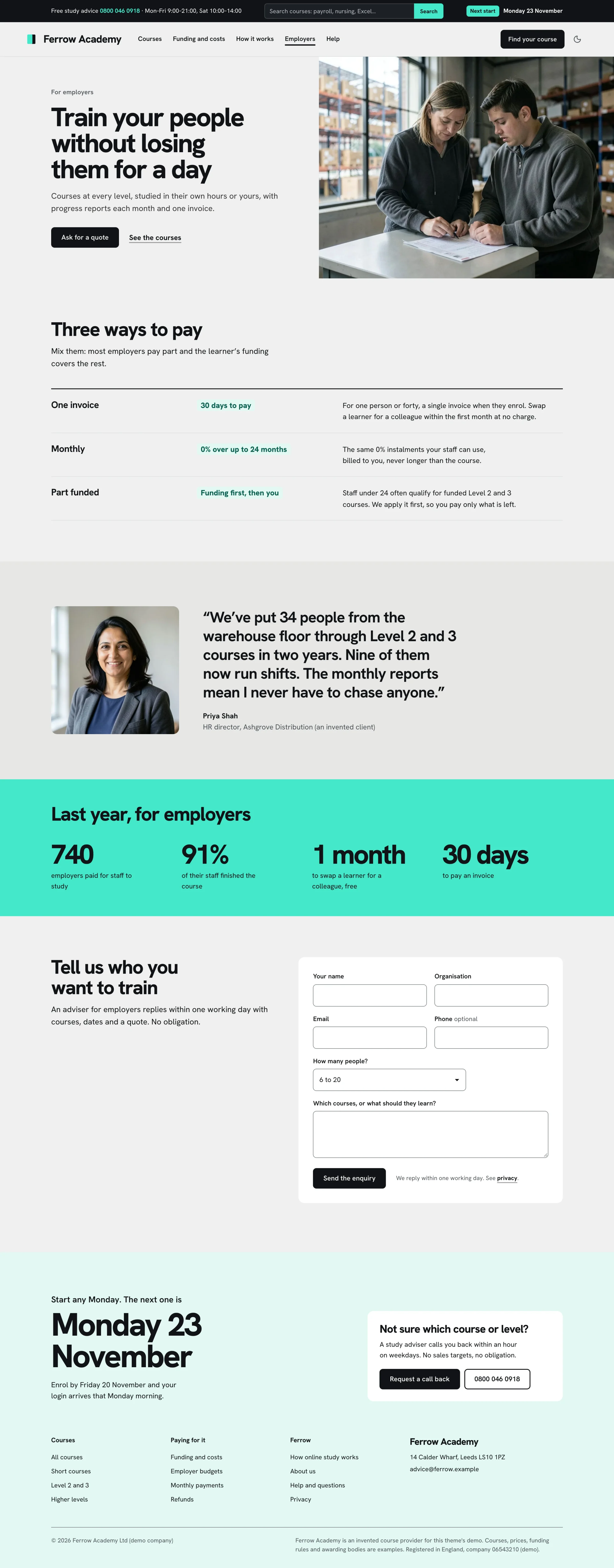
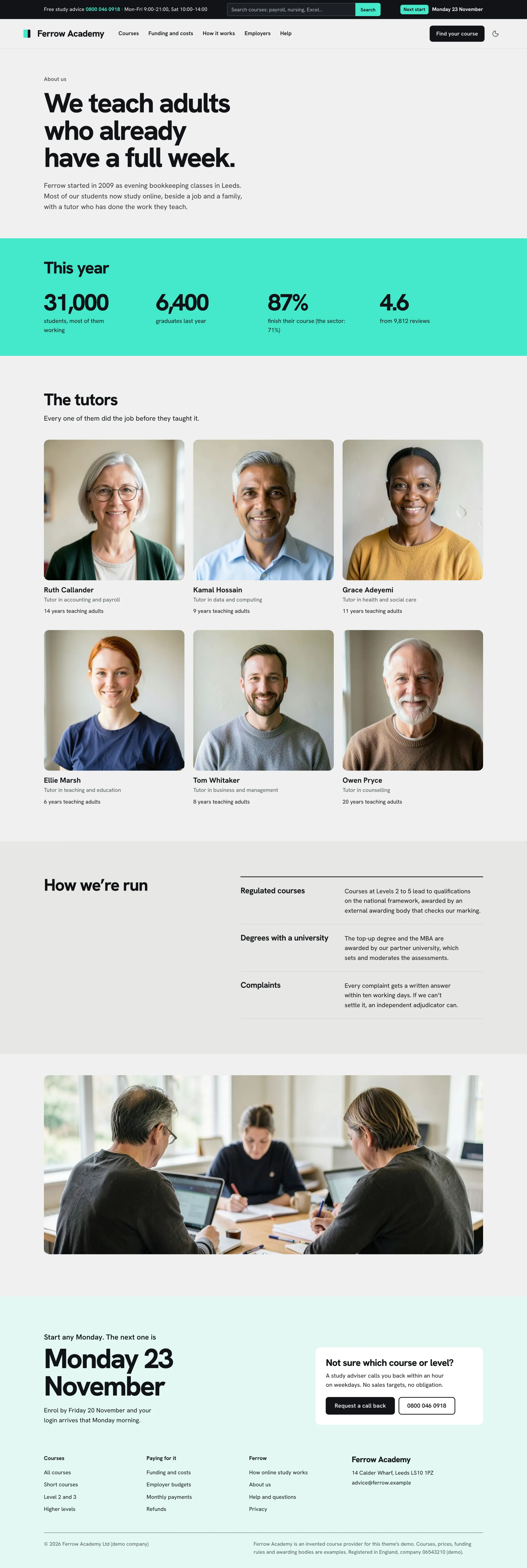
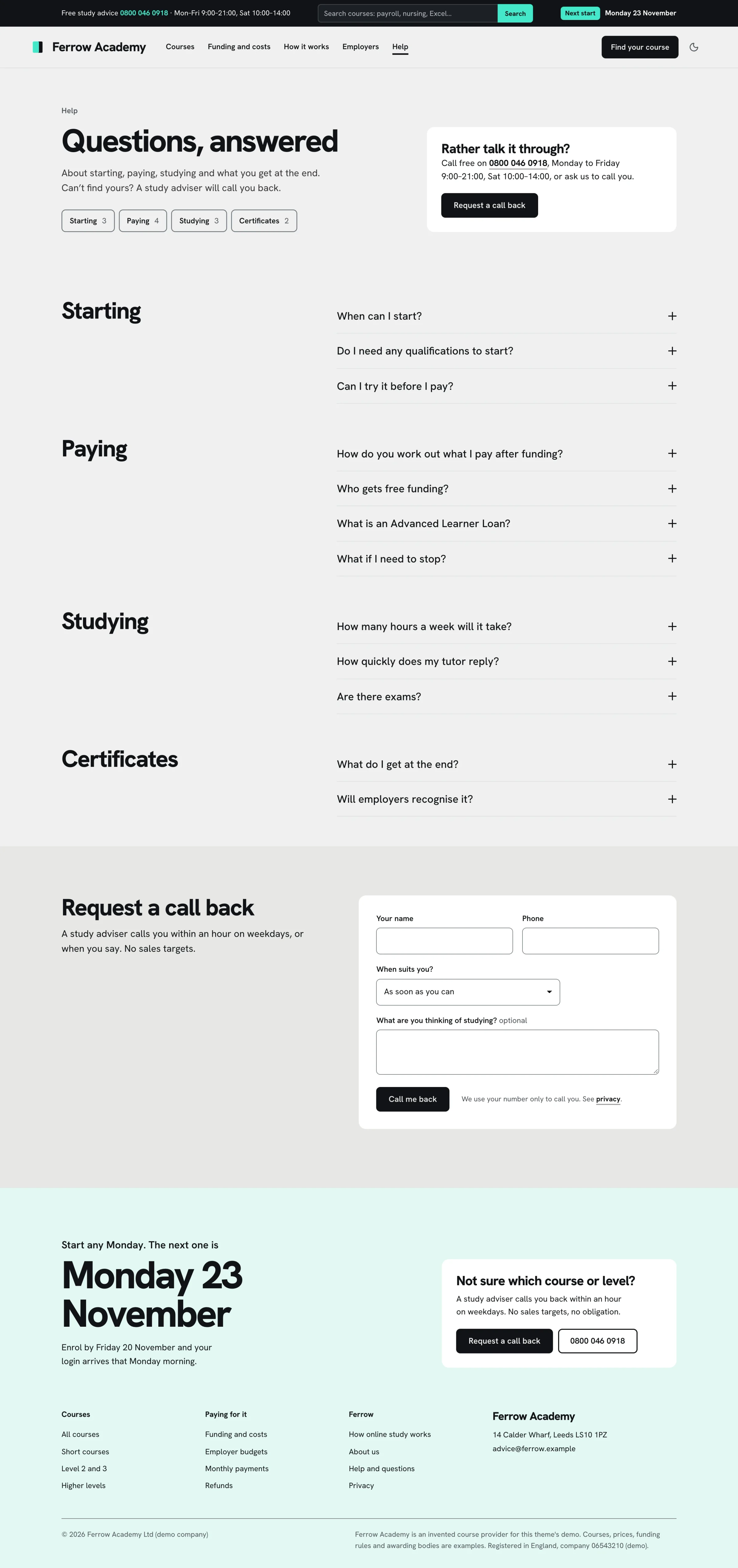
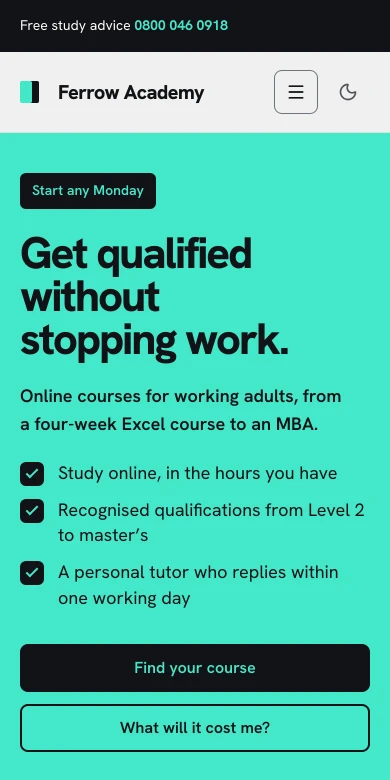
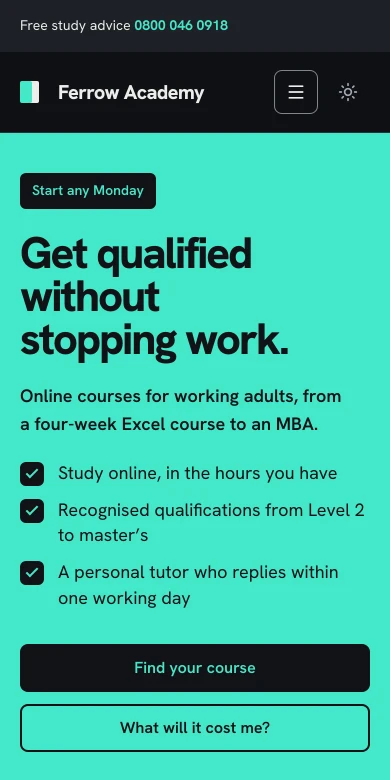
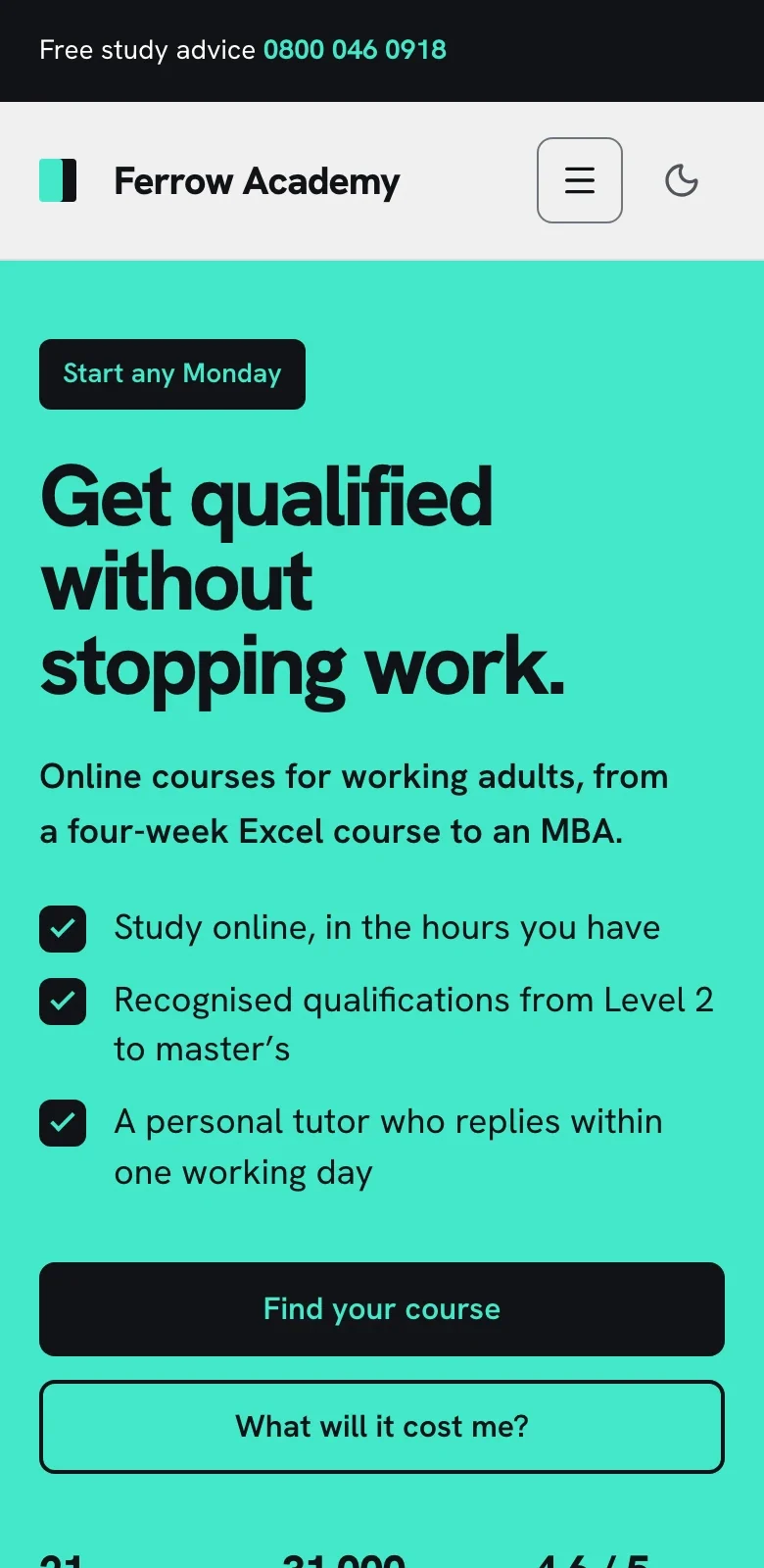
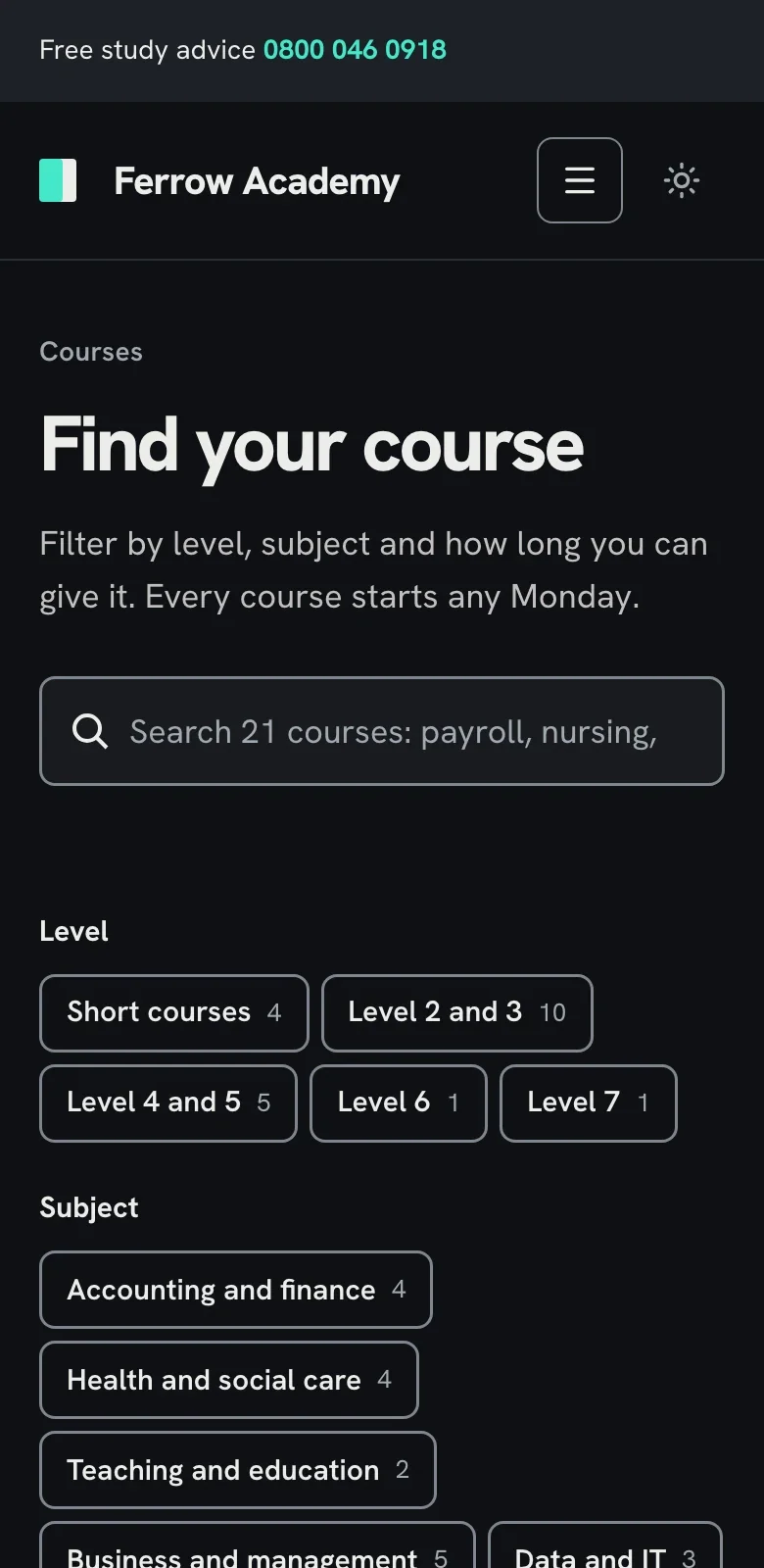
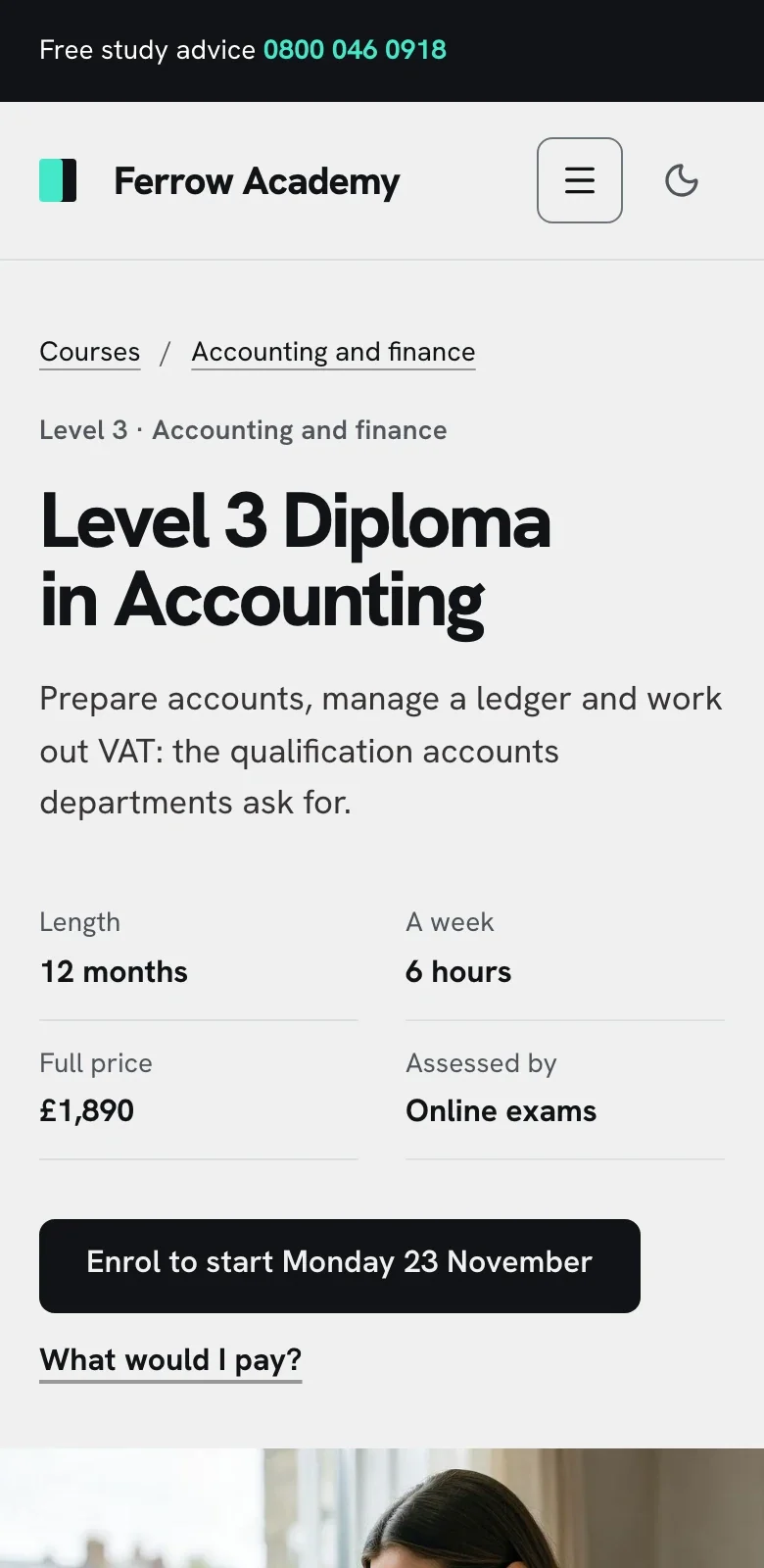
As considered on a phone.
Every page is checked at phone width in both modes. On a phone the next start date is on the first screen, the cost block shows the sum it works out, and each course keeps its price, length and next start.
Two editions, one license
Static files or a Studio. Same design.
Both editions render the same pages from the same sections and presets, so you choose by who edits the site, not by how it looks. Your license includes both.
- Framework
- AstroAstro 7, static output
- Next.js + SanityNext.js 16, App Router and React Server Components
- Content
- AstroCourses, subjects, tutors, stories and questions in files with a schema; funding rules in one settings file; page copy in one typed file
- Next.js + SanitySanity Studio with documents for courses, subjects, tutors, stories, questions, site settings and page copy
- Start dates
- AstroComputed at build time, and moved on by a small script if the site has not been rebuilt
- Next.js + SanityComputed on each render, so a long-running server never offers a past start
- Demo content
- AstroIn the repository
- Next.js + SanityA seed script imports every course, tutor, story and image into your dataset
- Publishing
- AstroRebuild and deploy
- Next.js + SanityPages generated ahead of time and refreshed when you publish
- Preview
- Astropnpm dev
- Next.js + SanityDrafts beside the form in the Studio
- Forms
- AstroThe call-back form and the employer enquiry post to the addresses you set, or to an optional Cloudflare Worker that forwards them and fails closed without a destination
- Next.js + SanityRoute Handlers that forward to your endpoint, fail closed without one and log no field values
- JavaScript
- AstroSmall scripts: the menu on phones, the light/dark switch, the catalogue’s filters and the cost calculator
- Next.js + SanityThe same small parts as client components; every page renders on the server
- Lighthouse, mobile
- Astro100
- Next.js + Sanity98–99
- Deploys to
- AstroCloudflare Workers, Netlify, Vercel or any static host
- Next.js + SanityVercel, or Cloudflare Workers through OpenNext
- Repository
- Astrothemesdev/copybook-astro
- Next.js + Sanitythemesdev/copybook-next
| Aspect | Astro | Next.js + Sanity |
|---|---|---|
| Framework | Astro 7, static output | Next.js 16, App Router and React Server Components |
| Content | Courses, subjects, tutors, stories and questions in files with a schema; funding rules in one settings file; page copy in one typed file | Sanity Studio with documents for courses, subjects, tutors, stories, questions, site settings and page copy |
| Start dates | Computed at build time, and moved on by a small script if the site has not been rebuilt | Computed on each render, so a long-running server never offers a past start |
| Demo content | In the repository | A seed script imports every course, tutor, story and image into your dataset |
| Publishing | Rebuild and deploy | Pages generated ahead of time and refreshed when you publish |
| Preview | pnpm dev | Drafts beside the form in the Studio |
| Forms | The call-back form and the employer enquiry post to the addresses you set, or to an optional Cloudflare Worker that forwards them and fails closed without a destination | Route Handlers that forward to your endpoint, fail closed without one and log no field values |
| JavaScript | Small scripts: the menu on phones, the light/dark switch, the catalogue’s filters and the cost calculator | The same small parts as client components; every page renders on the server |
| Lighthouse, mobile | 100 | 98–99 |
| Deploys to | Cloudflare Workers, Netlify, Vercel or any static host | Vercel, or Cloudflare Workers through OpenNext |
| Repository | themesdev/copybook-astro | themesdev/copybook-next |
What's inside
31 pages from 20 sections.
Each page is a short list of sections: the first screen with the next start, the levels, the cost after funding, the dated route, the stories and the rest. Each course is one entry with its modules, price and tutor, so it shows in the catalogue, its subject, the cost block and its own page. Start dates are computed from the build date, with a start every Monday.
- Home
- The next start date and what it costs, answered on the first screen; courses by level, the cost after funding, the dated route from enrolling to the certificate, graduates who studied beside a job, and employers.
- Courses
- The catalogue with a search and filters for level, subject and length, kept in the address. Every course is a typeset row with its hours a week, length, full price, the price a month and its next start.
- A page per course
- Facts and the enrol link, the next four start dates, the modules with hours and assessment, the cost after funding for that course, the tutor, entry and outcomes, three questions and more in the subject. A Course with its Offer and a CourseInstance per start date, and the course as Markdown.
- Funding and costs
- The cost calculator, the funding routes as typeset rows, three worked sums as a table and the questions people ask before they enrol.
- How online study works
- A week as day rows, the study plan drawn in the theme’s own tokens, a photo split and what you need to start.
- Employers
- Three ways to pay, a client quote, the figures and an enquiry form.
- About and help
- The statement, the figures, six tutors and how the provider is run; twelve questions in four groups and a call-back form.
- The rest
- A sample privacy page, the thank-you page and a 404.
Two looks, one line apart.
Everything a section draws comes from the preset’s tokens: colours, type, space and corners. Copybook uses an off-white page with an aqua for the answers; Margin is the same pages on white with a blue-violet. Both are set in Hanken Grotesk, and both are checked for contrast in light and dark.
Checked, not promised
Accessible and fast, page by page.
These checks ran on every page of both editions, in light and dark, at desktop and phone widths.
- WCAG 2.2 AA
- Zero axe violations on all 31 pages, in light and dark, at desktop and phone widths, in both editions, and on the Margin preset.
- Fast on a phone
- Lighthouse performance on mobile: 100 for the Astro edition and 98–99 for Next.js, on the home page, the catalogue and a course. Every photo is served at twice its drawn size for sharp screens and at its own size for the rest.
- Checked at 17 widths
- The main pages measured from 320 to 5120 pixels in both modes, and looked over by reviewers in three rounds: no sideways scrolling, no clipped text.
- The cost, as a sum anyone can check
- The cost block takes a course’s price, the funding for the learner’s age and level and their employer’s budget, and writes the answer as a sum: price, less funding, less the employer, divided by the months. Without JavaScript it shows its worked example.
- A start every Monday
- The next start date and the next four on every course come from the build date, and a small script moves them on if the site has not been rebuilt. In the Next.js edition they are worked out on each render.
- Structured data for courses
- The provider as an EducationalOrganization and WebSite, every course as a Course with its Offer and a CourseInstance per start date, FAQPage on help, funding and every course, and breadcrumbs. A sitemap, llms.txt and every course as Markdown.
- Design rules, checked
- Colours only from the preset, images with alt text and a size: pnpm lint holds every page to it, yours included.
Delivery
A zip, or straight from GitHub.
Download both editions from your account, or connect GitHub and get read access to the private repositories. Each release is one tagged commit, so updating is a pull.
$ git clone git@github.com:themesdev/copybook-next.git
$ cd copybook-next && pnpm install
$ pnpm dev      # the demo content, until you connect Sanity
$ pnpm seed # then import it into your own dataset- 01Buy a licensePay once. The license belongs to your organisation; owners and admins hand out the seats.
- 02Connect GitHubIn your account, sign in with GitHub once. We learn only your username, and invite it read-only to both repositories.
- 03Pull updatesUpdates are free for life. Access follows your license, and the zip stays in your account next to it.
Pay once. Both editions.
Unlimited projects, private, commercial and for clients, with every future update of both editions. Prices exclude VAT; we sell to businesses. License details
A small studio building sites for schools and colleges: everyone gets their own seat.
Choose Team
A registered Dutch company, KvK 01129853. Questions before you buy? Ask me.
Paying
Through Mollie: card, Apple Pay, iDEAL, Bancontact or PayPal. A proper invoice for every order, with EU reverse charge.
Updates
Galley 2.0.0 came out on . 27 releases across our themes in the last 30 days, all free for buyers.
Track record
400+ teams and developers have bought from themes.dev since 2020. Their licenses now live in their accounts here.
What's new
Updates for both editions, free.
v1.0.0
Latest
The first build of Copybook, for online and part-time course providers, colleges and adult education.
Astro
- Home: the aqua field with three promises, two actions and proof figures, a photo off the right edge with the next start date; courses by level with their counts, hours and from-prices; subjects; what it costs after funding; the route from enrolling to the certificate, dated from the next start; graduates who studied beside a job; employers.
- The course catalogue with a search and filters by level, subject and length, kept in the address.
- A page per course: facts and an enrol link, the next four start dates, the modules with hours and assessment, the cost after funding for that course, the tutor, who it is for and where it leads, three questions, more in the subject.
- Funding and costs with the calculator, the funding routes and three worked sums; how online study works; employers with an enquiry form; about with the tutors; help with every question and a call-back form; privacy, thanks, 404.
Next.js + Sanity
- Every route of the Astro edition: home (the next start date, courses by level, the cost after funding, the dated route to the certificate, graduates' stories, employers), the catalogue with its filters, a page per course (with its Markdown copy), funding and costs, how online study works, employers, about, help, privacy, the thank-you page and the 404; Open Graph images,
llms.txt, robots.txt and the sitemap. - The cost after funding, the start dates and the catalogue's filters run the Astro edition's code (
src/lib/cost.ts,src/lib/start.ts,src/scripts/) on the markup the server draws. Pages are drawn again in the background, so the start dates move on without a rebuild. - Sanity Studio: the Site (the figures and the funding rules the calculator applies) and the page copy (one document each), courses with their modules, subjects, tutors, graduates' stories and help questions. The Presentation tool and draft mode (redirects through the library's
safeRedirect). - The demo content in
seed/, written from the Astro edition's content (pnpm seedimports it); without a Sanity project the site reads it directly.
Questions
Do I get both editions?
Yes. Copybook is one product: every license includes the Astro theme and the Next.js + Sanity edition, as a zip and as two private GitHub repositories. Use either or both in any project your license covers.
Which edition should I use?
The Astro edition if a developer keeps the site: courses are files in the repository and the output is plain static HTML on any host. The Next.js + Sanity edition if the school’s own staff add and change courses, tutors and stories: a form in the Studio with a live preview, and nobody touches code.
Are the funding rules real?
No. Ferrow Academy and its funding are invented: funded in full under 19, and for a first Level 2 or 3 at 19 to 23, an Advanced Learner Loan for Levels 3 to 6, and 0% spreads of up to 24 months. They live in one settings file. Replace them with your own rules and check the wording against the funders’ and your regulator’s.
We are a school for children or a university. Does it fit?
It is built for adults studying online or part time, where the questions are the start date and the cost. A college with a short course catalogue fits. A school with admissions by age, or a university with degrees, entry grades and campuses, would need a different structure for the catalogue.
Does the enrol button take payment?
No. Each course links to an enrolment page you set, such as your own system or a payment provider. The theme shows the price and the cost after funding and does not take money.
What happens to the forms?
The call-back form and the employer enquiry are plain forms that work without JavaScript, with a hidden field that catches bots. In the Astro edition they post to the addresses you set: a form service, your CRM, or the optional Cloudflare Worker that forwards them. In the Next.js edition they post to the site, which forwards the fields to the address you set; without one it accepts nothing. Neither edition stores what people send.
Do I need a paid Sanity plan?
No. Sanity’s free plan is enough for this theme. The README walks you through the project, tokens and the seed script.
How does the GitHub access work?
In your themes.dev account, connect your GitHub account once by signing in with GitHub. You then get a read-only invitation to themesdev/copybook-astro and themesdev/copybook-next. Every release is a tagged commit there. Access follows your license: a seat you lose or a refund ends it. The zip stays in your account either way.
Can I build sites for clients with it?
Yes, in unlimited projects. A site you build with Copybook for a school is theirs: they may own, host, edit and keep running it without a license of their own. They may not take Copybook out of that site to build other sites.
Can I see it before buying?
Yes. The live demo is the Astro edition with every page, and the screenshots on this page show them in light and dark. Ferrow Academy and everything in it is invented: people, courses, prices, funding rules and figures. The photos are generated and show fictional people.
Do you charge VAT?
We sell to businesses. Dutch businesses pay 21% VAT; businesses elsewhere in the EU with a valid VAT number pay none (reverse charge); outside the EU there is no Dutch VAT. You get a proper invoice by email.
Is Copybook an official Astro, Next.js or Sanity product?
No. Copybook is made by themes.dev and builds on the open-source Astro, Next.js, Tailwind CSS and Sanity projects; it is not affiliated with them.
Put your courses on Copybook.
From €49 for one person to €349 for your whole company. Both editions, pay once, lifetime updates.